
TECHNOPAST FRANCE
30110 Branoux


Fabrication de pâtes, machines professionnelles, pâtes par extrusion
06- Kneading: an essential stage in dough production
- Details
- Hits: 6159

This is the first phase of the production process. The final result will depend in part on the quality of this operation, which consists of obtaining a perfectly homogeneous mixture by mixing the 'solid' part (semolina/flour) with the 'liquid' part (water or water plus eggs, or even other liquids, such as wine, for example, which is used in the composition of certain Italian specialities, such as Barolo pasta).
The kneading vat: the first stage of processing
Extruders or sheeters are usually equipped with a bowl, known as the 'kneading bowl', with a horizontal mixing shaft fitted with specially designed blades to ensure correct mixing.
Once the mixing operation is completed, i.e. when the dry part is homogeneously hydrated, the kneading stage is finished and the next stage (rolling or extrusion) can be carried out.
At this stage of the production process, the mixture must be in granular form, with the agglomerated semolina forming small balls one to two centimetres in diameter.
In the case of industrial production, dosing devices ensure the precise supply of semolina, water mist and eggs.
07- The different pulp production technologies
- Details
- Hits: 17111
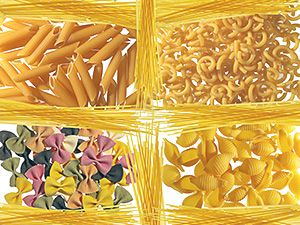
1) Pasta production by extrusion (extruders or presses)
This process uses an Archimedes screw, commonly known as an "endless screw", which exerts a thrust inside the extrusion neck to make the mixture (previously kneaded) pass through dies, at the exit of which the pasta is formed. This type of equipment is the most versatile, as the machines are capable of producing all shapes of pasta, long or short, as well as 'flat' pasta, such as noodles, or abaisses (sheets of dough).
The pressure exerted by the Archimedean screw is on average 100 kg per cm2 for professional machines. This pressure causes heating after a long production period. The temperature must remain below 50°C to avoid deterioration of the physical and nutritional qualities of the semolina. Therefore, it is useful to cool the extrusion tube, especially if the machine is working continuously. Depending on the size of the extruder, cooling is achieved by simply circulating a stream of water through the cooling device around the neck or by using a cooling unit, which ensures a precise and constant temperature.
Extrudate characteristics:
In addition to its versatility, extrusion dough production is characterised by a denser and firmer dough.
The type of dies can also influence the final result.
- Bronze dies, which give the dough a more rustic and rough "old-fashioned" look and which, according to enthusiasts, "catch" the sauce better.
- dies with Teflon inserts, which give the pasta a smoother and more attractive appearance. Smaller presses are often used with Teflon-coated dies, as these promote "better sliding" and thus improve production capacity. But industrial lines are also adopting them, to improve their production output.
2) Production of pasta by rolling
This process consists of passing the mixture from the kneading vat (a mixture made with semolina/liquid proportions identical to those of extrusion), between cylinders that will roll out the dough in several stages.
With a semi-automatic sheeter, the operator will have to take the kneaded dough and pass it between the cylinders of the sheeter to stretch it little by little, reducing the thickness each time, until a sheet is obtained.
In semi-industrial or industrial production units, the system is automated and at the exit of the mixer, the mixture passes to a lamination group inside the body of the machine, to be mixed by rolling mills. At the exit of the laminating unit, the sheet (plate) is placed on a conveyor belt and wound onto reels. These coils can be used to feed ravioli machines, machines for the production of nests or Farfale (butterflies) and noodle cutting machines.
Rolling is a less versatile technique than extrusion: it produces a 'sheet' of dough, but not short pasta, such as Fusili, or long, spherical pasta, such as Spaghetti. However, this 'sheet' can be cut into tagliatelle of different widths or into square spaghetti 'alla chitarra'. This technique also produces a softer dough, very suitable for stuffed pasta (ravioli, tortellini, etc.) and fresh tagliatelle.
08- Fast consumption of fresh pasta and ravioli
- Details
- Hits: 20427

Keep for 3-4 days in the refrigerator at 4°C.
After production, extruded or rolled pasta and ravioli can be consumed immediately.
The only thing to do is to cook them in boiling water. Obviously, this cooking is very fast because the moisture content is close to 30%, whereas in the case of dry pasta, the moisture content must be restored during cooking, which can take between 8 and 12 minutes, depending on the size and type of pasta or raw material (hard or soft wheat pasta).
B) Deferred consumption :
If the shelf life of fresh pasta and ravioli is to be extended, specific treatments are necessary
Preservation methods for fresh pasta and ravioli
1) Modified atmosphere packaging
This method is applied to both plain pasta (short and long pasta) and filled pasta (ravioli). It consists of expelling the ambient air by means of a pump and replacing it with a so-called 'neutral' gas.
The shelf life is extended to about one week, provided that the pasta and ravioli are kept at a temperature of 4-5 °C.
This treatment has the advantage of respecting all the organoleptic qualities of the product (flavours and colours are not altered) and of being totally natural, as no preservatives are used.
(2) Pasteurisation and then modified atmosphere packaging
If this process is applied, the best-before date can be extended to around 42 days if the pasta and ravioli are sterilised after packaging and kept at a temperature of 4-5 °C.
3) Freezing and bagging.
This consists of quickly transporting the pasta and ravioli to a freezing cell, directly after leaving the production machines.
09- Pasta drying: with static dryers or with a drying tunnel
- Details
- Hits: 17464

In the case of small and medium-sized pasta production units, the static dryer is the most suitable, up to a production capacity of 500 kg. These are semi-automatic lines, with a greater or lesser degree of automation, depending on their hourly production capacity.
These dryers have a fresh pasta input capacity ranging from 100 kg to 800 kg. Heating is provided by electric heating elements or hot water coils. The hot water coils are operated by a superheated water generator. The choice of hot water coils can be considered as the capacity of the dryers increases (from 400 kg) and the number of dryers on the same line increases. These factors must be correlated with the cost of the energy source to which users have access locally: electricity, gas or fuel oil.
The main advantage of static dryers is that they dry at a relatively low temperature (around 40-42°C), which allows all the nutritional qualities of the wheat to be preserved. On the other hand, the drying time is between 10 and 15 hours, depending on the type of pasta and raw material.
The industrial production units are fully automated and work continuously. The drying phase starts systematically in a pre-dryer, which will transport the pulp to the drying tunnel where the temperature is raised to 90°C. The throughput time is much shorter. The passage time is much shorter and at the exit, the pulp is cooled and then packaged or stored in a silo until packaging.
This high temperature means that some nutritional properties are lost, but there is a clear gain in productivity.
Shelf life of dried pasta: 3 years with water / about 20 months with eggs.
Drying the pasta: a step not to be underestimated
Whatever the drying method, it must be rigorous and offer every guarantee of quality, otherwise the pasta, even if it is apparently dry, risks deteriorating rapidly: poor cooking properties, brittleness or, worse still, rising damp in its packaging, with mould. This is why it is important to use drying cells with high-quality electronic components and to avoid overloading the pasta trays.
Standard dryers calculate their capacity by loading each pasta tray with 4 kg. Thus, the fresh pasta input capacity will be 100 kg for standard dryers with 25 trays, 200 kg for 50 trays, etc.
TECHNOPAST considers that this does not allow a homogeneous drying, so it is recommended to load the trays with 3.3 kg of pasta.
To remedy this overload, while maintaining the advertised capacities, TECHNOPAST prefers to offer pasta dryers with 31 trays per trolley. With this principle, a 100 kg drying cell, containing a trolley with 31 trays loaded at 3.3 kg, contains 102 kg of fresh pasta as input. Whereas if the 25 trays of a standard 100 kg drying trolley were loaded at 3.3 kg, they would contain only 82.5 kg. This represents a capacity loss of 70 kg of fresh dough as input for a 400 kg dryer.
Our static dryers also benefit from advanced technology, high-precision measuring devices and specially designed internal geometry for optimal circulation of ventilated air and heating.
The vibratory pre-dryer (trabatto)
The vibratory pre-dryer is indispensable in lines using drying tunnels, but it is also recommended for pre-drying before entering the static dryer. The pulp will pass through the different levels of the machine (7 in general) where it will be subjected to ventilation with moderate heating, thus avoiding the risk of sticking, thanks to the vibrations. This treatment will also remove about 4% of the moisture and shorten the drying time by about 3 hours. It will also prevent the deformation of certain formats and improve the appearance of the pastes.
10- Pasteurisation of fresh pasta and ravioli: the different steps
- Details
- Hits: 10552

Pasteuriser
For the pasteurisation of the products in the core. This involves exposing the products to a heat treatment for a period of time determined by their thickness or the type of filling (in the case of ravioli or cappelletti). The treatment consists in the projection of a 90°C steam jet. The smooth, filled pasta is dried on the surface and cooled before being packaged in a modified atmosphere.
Vibratory drying tunnel
In medium and large capacity production lines, the pasta and ravioli will pass through a vibrating tunnel (called "trabatto") at the exit of the pasteuriser for surface drying. The pasta and ravioli pass through the various levels of the machine, where they are subjected to moderately heated ventilation, which not only removes the surface moisture but also prevents the products from sticking together due to the vibrations.
Cooling cell or tunnel
The function of this equipment is to quickly lower the temperature of the product below 10ºC before packaging, thus avoiding bacterial proliferation, which is important between 70ºC and 10ºC.
Steriliser
After ATM packaging and in order to prolong shelf life, the bag or tray can undergo additional treatment in a steriliser, which will allow a period of up to 54 days, depending on the type of filling. Tests should be carried out to determine, with a margin of safety, the best-before date to be indicated on the packaging.
Note: for small production lines, it is preferable to settle for a shorter BBD, in order to limit the need for excessive investment, given the production capacity.
Page 2 of 3
